
Understanding how banks work is a complex process, especially when it comes to compliance and the frameworks banks work from to manage risk. The framework is most easily understood when broken down into individual components and evaluated in the context of overall third-party risk management.
Technology Implementation and Governance
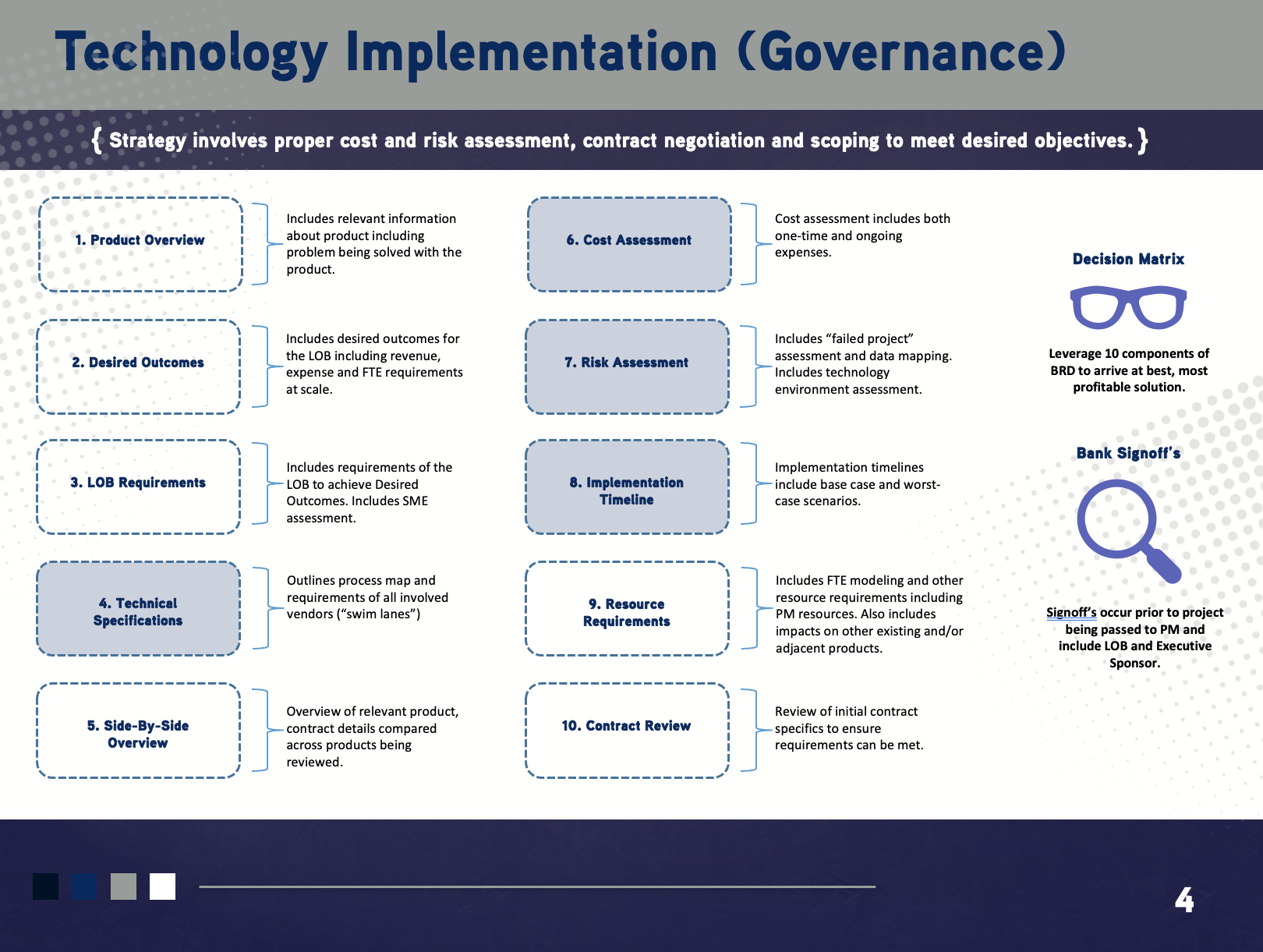
Strategy as it relates to the onboarding of technology, when done to meet the expectations of internal and external auditors, incorporates proper scoping of a project, costing and risk management along with expert contract negotiation to achieve the desired outcomes.
Product Overview
A thorough product overview is an important component of the implementation framework. The product overview needs to be completed through the lens of the various groups within the bank that will influence the buying decision. These groups include not only the line of business driving the need for a solution, but also the groups responsible for evaluating and managing compliance, risk and ongoing maintenance of the product.
Desired Outcomes
Desired outcomes will vary depending on the group evaluating the product. To the extent the product is being championed by a revenue producing line of business the desired outcomes will naturally be revenue and return oriented. However, if the group evaluating the product is compliance or operations oriented the outcomes could be much different. For example, from an operational perspective, the product may be the right one from a revenue perspective, but to the extent it is going to require FTE's to setup, manage and maintain the product the calculus becomes much different. Card programs are a great example of a products that can drive new revenue for a bank, but likely include new FTE's to manage the risk and fraud aspects of a program.
LOB Expectations
Understanding the expectations of the line of business are important. Beyond just driving revenue, there could be expectations around efficiency gains or even FTE reductions driving expectations. Thoroughly interviewing stakeholders as a method to understand and document expectations is time well spent in the overall context of a technology implementation.
Technical Specifications
Technical specifications are mission critical in the overall scheme because they are used to understand a variety of factors in a technology project. For banks, technical specifications including hosting, maintenance, data sharing and security are common aspects to understand and document. Banks want to identify where their risks are from a data perspective, third and fourth party risk management perspective and from a cost perspective. Being able to provide a bank a detailed overview of the technical specifications of a product are important to the overall sales process and must be documented.
Side-By-Side Assessment
A side-by-side assessment of the products being evaluated to solve a certain problem is a critical item in a technology implementation. The assessment must include contract parameters, detailed cost assessments and resource assessments.
Cost Assessment
There are several different aspects of overall cost to a bank. In the context of a technology project costs include things like implementation fees and annual fees, but also include volume or usage based fees like API calls. In addition to the costs of the product there are also costs associated with additional resources that may be necessary like new FTE's or additional ongoing costs to meet regulatory requirements.
Risk Assessment
Risk assessments are generally completed per the requirements of an internal or external auditor. Risk assessments often include risks associated with business continuity and third-party risks the banks are assuming when deciding to work with a vendor. Risks are also present from a data perspective as most fintech products require integration with the core banking or digital banking provider. All of these risks must be evaluated on the front end of a project to set the bank up for success.
Implementation Timelines
Implementation timelines are often a sticking point in the overall context of a technology project. From the banks perspective, it can often take weeks or months to get to a point where there is a mandate to move forward on a certain project. From that point the time necessary to evaluate and choose a vendor, negotiate a contract, go through implementation can add additional months to a project. Helping a bank understand and document implementation timelines is among the most critical components of an implementation and must be accurately communicated by the fintech or vendor.
Resource Requirements
There are always going to be additional resources necessary to manage a technology project. These resources necessary will likely include resources from the line of business, but also from operations, risk and project management. It is important to communicate clearly the resources that will be provided from the fintech's perspective, but also the resources that will be required from the bank to have a successful implementation.
Contract Review
Contract negotiation and review is often a time consuming, but important part of the process. Often, there are numerous parties involved both internally and externally including various parties from inside the bank, parties from the vendor and usually outside legal counsel. It is important for the fintech to provide visibility early in the process of both the legal and business aspects of a contract in an effort to make the process as efficient as possible.
Lessons Learned: Good Documentation Wins
Good documentation, provided by the fintech to the bank early in the process is always a winning strategy. The documentation outlined in the post in a clear and concise manner that the bank can interpret easily shows the bank that the fintech is capable of managing an enterprise sale.
The Enterprise Sale
Most community banks are operating from relatively slim technology budgets, much of which are consumed by the cost of the core banking and digital banking technology. While fintech's see their contract costs as fairly modest, five and six figure investments, banks see these costs as significant and treat virtually every project as an enterprise sale. Fintechs need to be prepared for the effort and level of diligence it takes to be able to sell fintech product to a bank.
The Importance of Documentation
Providing a bank well thought out documentation is a critical element of making an enterprise sale. Evaluating and documenting all the things the bank is going to want to know or see early in the process will likely help accelerate the sales process and trim months off the overall timeline.
Actionable Advice: Where to Start
Evaluating each component of the above technology implementation and governance chart is the place to start. Developing comprehensive documentation to be able to provide to the bank (in advance of them asking for it) will likely cut valuable time from the overall timeline and enhance credibility from the beginning of the sales process.
Provide Documentation Early
It should be clear at this point the value of good documentation in the sales process. However, what may not be so clear is the right time to provide that documentation. As the fintech is working to engage the bank at the front end of the sales process, the sales team should be communicating all the documentation and resources it has available and who those resources should be shared with internally. Ideally, this information is shared with a project lead or executive sponsor and disseminated internally. However, occasionally the process is fragmented and different parts of the documentation are shared with different people or groups. Developing the ability to distribute the right information to the right people is an important part of the process.
Understand Who Will Influence
From the perspective of the fintech and the bank, understanding who all will be involved and who needs to be involved is a key to success. Asking the right questions and validating that all stakeholders are alighted is critical. Developing a mechanism to communicate effectively, share documentation and maintain alignment will trim months from a long sales cycle.
Final Thoughts: Be Prepared
Take the time to do the work of developing best-in-class documentation as part of the sales process. The effort to understand and document all the areas the bank cares about and has to compensate for from a regulatory perspective will prove valuable in the long run. Most fintech's do not take the time, but those that do stand out.
About Finov8r
Finov8r is a leading embedded advisory consultancy that supports banks, fintechs, and corporations. Bridging finance and technology, Finov8r provides tailored solutions that foster profitable growth, simplify technology complexities, and deliver 5x ROI through fintech innovations. With hands-on advisory, Finov8r works within teams to achieve long-term results, unlock new revenue streams, and modernize operations. For more information, visit finov8r.com and follow on LinkedIn.
Get In Touch
-
Bank executive, fintech founder or business owner and want to get in touch regarding Finov8r advisory? Email me at allan@finov8r.com.
-
Media or speaking engagements please contact William Mills Agency in Atlanta.